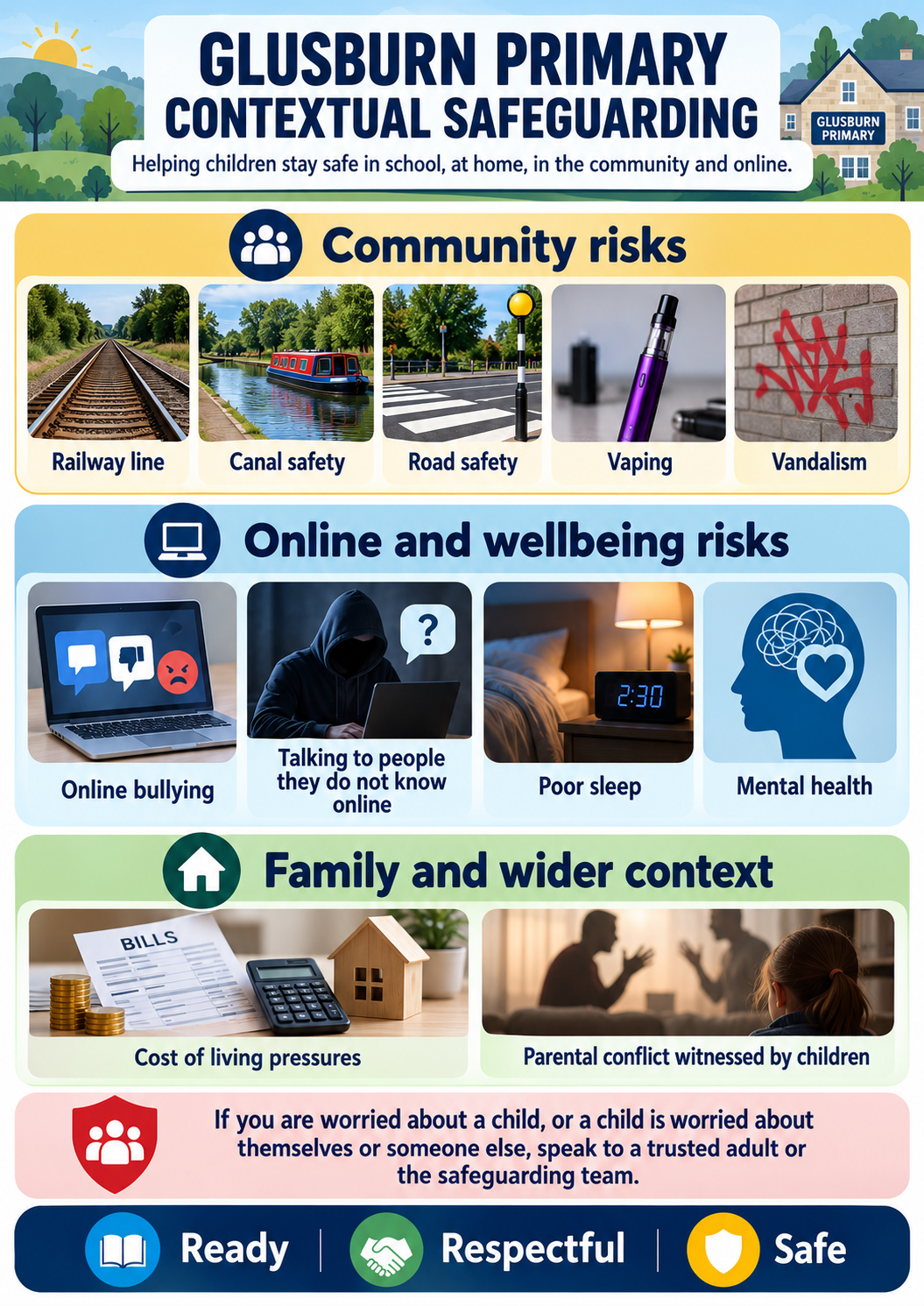
Contextual Safeguarding – How We Address Risks in School
At Glusburn Primary School, safeguarding is about more than keeping children safe while they are on the school site. We recognise that children’s experiences at home, in the local community and online can all affect their safety, wellbeing and ability to learn.This is sometimes referred to as contextual safeguarding. It means understanding the wider circumstances in which our children are growing up and making sure they have the knowledge, confidence and trusted relationships they need to stay safe.Our approach is preventative as well as responsive. We regularly consider issues affecting children and families in our local community and adapt our curriculum, assemblies, pastoral support and work with outside agencies accordingly.
Learning how to stay safe
Safeguarding is woven throughout our curriculum rather than being taught as a one-off topic. Through age-appropriate lessons, assemblies, discussions and regular reminders, children learn how to recognise risks, make safer choices and ask for help.Our teaching includes:
- Road safety, including crossing roads safely, being visible and developing greater independence safely as children get older.
- Railway safety, helping pupils understand the serious dangers associated with railway lines, crossings and railway property.
- Canal and water safety, including the risks around canals and open water and what children should do in an emergency.
- Online safety, including respectful behaviour online, cyberbullying, privacy, gaming, messaging and what to do if somebody they do not know makes contact with them.
- Vaping and other harmful substances, taught in an age-appropriate way so that children understand the potential risks and are prepared for situations they may encounter as they grow older.
- Vandalism and antisocial behaviour, considering respect for our community, property and other people.
- Healthy sleep and wellbeing, helping children understand how routines, sleep, physical activity and screen use can affect how they feel.
- Mental health and emotional wellbeing, developing children's emotional vocabulary, resilience and understanding of where to seek help.
Teachers revisit key messages throughout the year so that children hear important safety information regularly rather than only once.
Working with specialist visitors
We complement our curriculum with carefully selected visitors and organisations who can reinforce important safeguarding messages.These may include police officers and other community safety professionals, who provide age-appropriate assemblies or sessions about matters such as road safety, antisocial behaviour, online safety and keeping safe in the community.We also welcome organisations such as the NSPCC, whose work can help children understand that they have a right to feel safe, recognise when something is not right and know which trusted adults they can speak to.Visiting speakers are used to strengthen the work already taking place in school and their messages are followed up by staff in lessons and discussions.
Helping children to speak up
One of the most important things we can give children is the confidence to tell somebody when they are worried.We regularly remind pupils that they can speak to a member of staff if something is upsetting them, whether it has happened at school, at home, in the community or online.Children are encouraged to identify the trusted adults in their lives and understand that they should keep telling someone until they receive the help they need.Staff are trained to listen carefully to children and to respond appropriately to safeguarding concerns.
Supporting families
We know that pressures on families can also affect children's wellbeing.Where families are experiencing difficulties, we aim to work with parents and carers to find practical sources of support at an early stage.Our Glusburn Pantry, stocked with food provided through FareShare, provides practical support for families who may be experiencing cost-of-living pressures. We want families to feel comfortable accessing this support when they need it.Where additional support would be beneficial, school can also work alongside services such as Family Help and other appropriate agencies. This might include help with family routines, parenting, emotional wellbeing, finances, housing or other circumstances that are having an impact on a child.Seeking support early can often prevent a difficulty from becoming a crisis.
Working together to keep children safe
Safeguarding works best when children, families, school and the wider community work together. We encourage parents and carers to tell us about circumstances that may be affecting their child. Even when something happens outside school, knowing about it can help us provide the right support during the school day. If you are worried about a child, or if your child tells you that they are worried about themselves or somebody else, please speak to a member of staff or contact our Designated Safeguarding Team.
Our shared message to every child is simple: Be Ready. Be Respectful. Be Safe.
Contextual Safeguarding – Supporting Your Child at Home
Children are growing up in a world that can present risks both online and offline. Families play an essential role in helping children understand these risks without making them frightened of the world around them. At Glusburn Primary School, we want to work in partnership with parents and carers so that children receive the same clear safety messages at home and at school. The most valuable thing you can do is create an environment in which your child knows that they can tell you anything, including something they think they may get into trouble for.
Talk little and often
Safeguarding conversations do not need to be frightening or formal.Short, everyday conversations are often more effective. You might talk about something you have seen while walking to school, something in the news, a situation in a television programme or something that has happened during an online game.Try questions such as:
“What would you do if that happened to you?”
“Who could you tell?”
“What would make that situation safer?”
“Would you feel comfortable telling me if something like that happened?”
Remind your child that if something makes them feel frightened, uncomfortable, confused or worried, they can always tell you or another trusted adult.
Staying safe in the community
As children become more independent, regularly revisit the rules you have agreed about where they can go, who they can be with and when they should return. Talk specifically about local risks, including:
Roads: practise safe crossing habits and gradually build independence appropriate to your child's age.
Railways: make it very clear that railway tracks and railway property are dangerous and are never places to play or take shortcuts.
Canals and open water: talk about slippery banks, cold water, currents and the importance of staying away from the water's edge unless appropriately supervised.
Antisocial behaviour and vandalism: discuss peer pressure and what your child can do if friends encourage them to join in with something they know is wrong or unsafe.
Make sure your child knows what to do if plans change or they become separated from friends or family.
Keeping children safe online
Take an active interest in your child's online world. Knowing which games, apps and websites they use makes conversations about online safety much easier.
Where possible:
- Keep devices used by younger children in shared family spaces.
- Use appropriate parental controls and privacy settings.
- Agree sensible limits around screen time and device use.
- Know who your child communicates with online.
- Remind children that people online are not always who they claim to be.
- Encourage children never to share personal information, photographs, passwords, their school, home address or location with strangers.
- Make sure your child knows how to block and report inappropriate contact.
- Talk about being kind online and explain that online bullying can be just as upsetting as bullying face to face.
Most importantly, reassure your child that if something goes wrong online, they should come to you rather than hide it because they are worried their device will be taken away.
Keeping communication open makes it much more likely that children will ask for help.
Vaping
Children may see vaping in the community, online or through older children and adults. Talk openly about what vaping is and why it is not appropriate for children. Correct myths they may encounter through friends or social media and encourage them to come to you with questions rather than relying on information from other children. It can also help to practise ways of responding to peer pressure, for example:
“No thanks.”
“I don't want to.”
“I'm going.”
Children should know that walking away and finding a trusted adult is always an acceptable choice. If you vape yourself, be open and honest with your children about why they should never start - Talk about its addictiveness, cost and impact on health.
Sleep and healthy routines
Sleep has an important impact on children's concentration, mood and wellbeing. Regular routines can help. Consider having a consistent bedtime, creating a calm period before sleep and keeping phones, tablets and gaming devices out of bedrooms overnight where possible. If poor sleep becomes persistent or begins to affect your child's wellbeing or attendance, please speak to us. We may be able to offer support or help you identify an appropriate service.
Supporting mental health and emotional wellbeing
Children do not always have the words to explain how they are feeling. Changes such as becoming unusually quiet, angry, withdrawn, worried or tearful can sometimes indicate that something is troubling them. Give your child opportunities to talk without immediately trying to solve the problem. Listening and showing that you have taken their concern seriously can make a significant difference. Help your child identify several adults they could speak to. These might include you, another family member, their teacher or another trusted member of school staff.
Please contact school if you are worried about your child's emotional wellbeing. Working together often helps us understand what a child needs.
Family pressures
Children can be affected by difficulties within the wider family even when adults try hard to shield them. Financial worries, relationship difficulties, separation, bereavement, housing problems or other pressures can all have an impact. If your family is going through a difficult period, you do not have to wait until things become overwhelming before speaking to us. School can help families access appropriate support, including Family Help, Food Banks and other local services, where this would be useful. Our Glusburn Pantry, supported with food from FareShare, is also available to help families experiencing financial or cost-of-living pressures.
Please speak to us confidentially if further help would be beneficial. Asking for help is a positive step and enables us to work together to support you and your child.
If your child tells you something worrying
If a child tells you something that concerns you, try to remain calm and listen. Allow them to explain things in their own words. Reassure them that they have done the right thing by telling you, but do not promise to keep information secret if somebody may be unsafe. Make a note of what your child has told you and contact school if you need advice or believe there may be a safeguarding concern. If you believe a child is in immediate danger, contact the emergency services by calling 999. If you have any concern about the safety or wellbeing of a child, you can also contact our Designated Safeguarding Team through the school office.
The message we want every Glusburn child to know
You have the right to feel safe.
If something worries you, tell a trusted adult.
If you are not heard the first time, keep telling until somebody helps.
At home, at school, in the community and online — we are working together to keep you safe.


 Search Site
 Translate Page